
ICML (Spotlight) · May 2026
Reasoning with Machines Lab · University of Oxford

A public-interest lab studying how machines reason.

The Reasoning with Machines Lab is a research group at the Oxford Internet Institute. We work on the science of evaluating language models and agentic systems, on AI safety, and on how these systems are used in healthcare, law, and public life.

Radcliffe Camera, the Bodleian Libraries, University of Oxford.
Radcliffe Camera, Bodleian Libraries, OxfordPhotograph · Public Domain
In residence
15 researchers
Most recent venue
ICML (Spotlight)
May 2026
Published works
10+ this cycle
Open positions
DPhil, 2026 entry
Rolling applications
Index · In press
ICML (Spotlight)May 2026ICMLMay 2026ICMLMay 2025Nature MedicineFebruary 2026NeurIPS Datasets and BenchmarksNovember 2025NeurIPS LLM Lifecycle WorkshopNovember 2025EMNLPNovember 2025EMNLPSeptember 2025Information FusionFebruary 2025ICLRApril 2026ICML (Spotlight)May 2026ICMLMay 2026ICMLMay 2025Nature MedicineFebruary 2026NeurIPS Datasets and BenchmarksNovember 2025NeurIPS LLM Lifecycle WorkshopNovember 2025EMNLPNovember 2025EMNLPSeptember 2025Information FusionFebruary 2025ICLRApril 2026
Programmes
Four long-running questions

We work on four questions. Each is published in the open.

We treat language models the way a public laboratory treats any new instrument: measure first, theorise second, publish the full method so others can check the work.

  • Open methods
  • Open code & data
  • Open critique
  1. § 1.1
    Evaluation

    Benchmarks and Evaluation

    We work on the science of LLM evaluation: what benchmarks measure, where they mislead, and how to build ones that hold up.

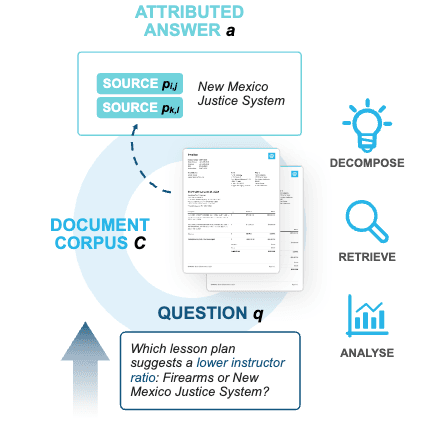
    RecentStrategic Navigation or Stochastic Search? How Agents and Humans Reason Over Document Collections
  2. § 1.2
    Safety

    AI Safety and Security

    We work on bias, toxicity, and agentic misalignment, and on the technical and governance tools that address them.

    RecentA Positive Case for Faithfulness: LLM Self-Explanations Help Predict Model Behavior
  3. § 1.3
    Agentic

    Agentic AI for Science

    Agentic systems for scientific work. We focus on keeping them reliable, transparent, and grounded in the domain.

    RecentStrategic Navigation or Stochastic Search? How Agents and Humans Reason Over Document Collections
  4. § 1.4
    Human-AI

    Human–AI Interaction

    Empirical studies of how people use AI in high-stakes settings: healthcare, law, and policy.

The same systems now answering medical questions, drafting policy, and mediating public information should be measured with the same care as any other tool that affects public life.
Lab statement of purpose
Recent publications
10 works · 2025–2026

What we have been publishing.

Peer-reviewed papers at ICML, NeurIPS, ICLR, EMNLP, and Nature Medicine. The lab keeps no private benchmarks. Read the work.

  1. 02May 2026A Positive Case for Faithfulness: LLM Self-Explanations Help Predict Model BehaviorH Mayne, JS Kang, D Gould, K Ramchandran, A Mahdi, NY SiegelICML
  2. 03May 2025It's a TRAP! Task-Redirecting Agent Persuasion Benchmark for Web AgentsK Korgul, Y Yang, A Drohomirecki, P Błaszczyk, W Howard, L Aichberger, C Russell, P H S Torr, A Mahdi, A BibiICML
  3. 04February 2026Reliability of LLMs as medical assistants for the general public: a randomized preregistered studyAM Bean, RE Payne, G Parsons, HR Kirk, J Ciro, R Mosquera-Gómez, S Hincapié, AS Ekanayaka, L Tarassenko, L Rocher, A MahdiNature Medicine
  4. 05November 2025Measuring what matters: Construct validity in large language model benchmarksAM Bean, RO Kearns, A Romanou, FS Hafner, H Mayne, J Batzner, et al.NeurIPS Datasets and Benchmarks
  5. 06November 2025Evaluating LLM-as-a-Judge under Multilingual, Multimodal and Multi-domain ConstraintsS Padarha, E Semenova, B Vidgen, A Mahdi, S A HaleNeurIPS LLM Lifecycle Workshop
  6. 07November 2025How Does DPO Reduce Toxicity? A Mechanistic Neuron-Level AnalysisY Yang, F Sondej, H Mayne, A Lee, A MahdiEMNLP
  7. 08September 2025LLMs Don't Know Their Own Decision Boundaries: The Unreliability of Self-Generated Counterfactual ExplanationsH Mayne, RO Kearns, Y Yang, AM Bean, E Delaney, C Russell, A MahdiEMNLP
  8. 09February 2025Review of multimodal machine learning approaches in healthcareF Krones, U Marikkar, G Parsons, A Szmul, A MahdiInformation Fusion
  9. 10April 2026LingOly-TOO: Disentangling Reasoning from Knowledge with Templatised Orthographic ObfuscationJ Khouja, K Korgul, S Hellsten, L Yang, V Neacsu, H Mayne, RO Kearns, A Bean, A MahdiICLR

A complete bibliography, including pre-prints and unreviewed working papers, is published on the lab's GitHub.

See full bibliography
People of the lab
15 researchers in residence

A small group of researchers, working in the open.

Portrait of Prof. Adam Mahdi
Principal Investigator
Prof. Adam Mahdi

Adam leads OxRML. The group studies how language models reason, how people work with them, and how agentic systems behave on real scientific and decision-making tasks. He won the Oxford Teaching Excellence Award in 2025.

Oxford Internet Institute, University of Oxford

Researchers, DPhil students, & affiliates

Alphabetical, by focus
  • Portrait of Felix KronesFelix KronesDPhil StudentMultimodal AI, digital health
  • Portrait of Djavan De ClercqDjavan De ClercqDPhil StudentAI and food security, LLMs
  • Portrait of Andrew M. BeanAndrew M. BeanDPhil StudentLLM evaluations, human–LLM interaction
  • Portrait of Yushi YangYushi YangDPhil StudentLLM & agentic post-training, AI alignment
  • Portrait of Harry MayneHarry MayneDPhil StudentLLM interpretability, AI safety, LLM evaluations
  • Portrait of Jessica RodriguesJessica RodriguesDPhil StudentKnowledge graphs, metascience
  • Portrait of Guy ParsonsGuy ParsonsDPhil StudentHealthcare AI, digital health
  • Portrait of Karolina KorgulKarolina KorgulDPhil StudentAI safety, agentic AI
  • Portrait of Ryan Othniel KearnsRyan Othniel KearnsDPhil StudentScience of evals, reasoning in LLMs
  • Portrait of Shreyansh PadarhaShreyansh PadarhaDPhil StudentAI for science, AI safety, LLM evaluations
  • Portrait of Mia KussmanMia KussmanMSc StudentHuman–LLM interaction, LLM evaluations
  • Portrait of Caleb TanCaleb TanMSc StudentLLM evaluations, reasoning
  • Portrait of Sebastian PetricSebastian PetricVisiting Policy FellowLLMs and financial time series
  • Portrait of Tristan NaidooTristan NaidooResearch AffiliatePublic health AI, LLM evaluations
How to work with the lab
Open to partners worldwide

We collaborate with people who care about getting AI right.

Three ways in. Each begins with a conversation, and each ends with published outputs the public can read. We do not run NDAs over findings; we work on questions that benefit from being in the open.

  1. Workshops for industry teams

    On-site sessions for product and ML teams on evaluation, safety, and agent reliability.

    Half-day to multi-week formats. For teams shipping LLM products in healthcare, finance, retail, and government.

    Book a workshop
  2. Tools co-built with engineering partners

    We work with engineering partners to turn lab work into tools other teams can run.

    Evaluation harnesses, safety dashboards, agentic-research platforms. We build them with partners we trust, carrying the research methods through to the code.

    See our builds
  3. Research partnerships

    Applied research collaborations with foundations, governments, and large companies.

    Multi-year programmes: shared roadmaps, sponsored DPhil studentships, named labs.

    Start a conversation

On the public record

  • University of OxfordHost institution
  • Oxford Internet InstituteAffiliated department
  • Nature MedicinePublished 2026
  • ICMLSpotlight & papers, 2026
  • NeurIPSDatasets & Benchmarks, 2025
  • ICLRAccepted, 2026
  • EMNLPMultiple, 2025
Notices & subscription
Issued quarterly
The lab newsletter

Quarterly updates from the lab, no noise.

New papers, open positions, partnership opportunities, and what we have been reading.

Unsubscribe in one click. We never share your email.